
Executive take: Agentic AI is moving from demos into operations. The teams that win will not be the ones with the most autonomous agents; they will be the ones that can prove what each agent saw, why it acted, and who reviewed the handoff.
Current AI coverage is no longer limited to chat assistants. Google News discovery for July 2026 surfaces agentic supply-chain coverage from Deloitte, supply-chain simulation and AI-agent coverage from Microsoft, manufacturing-agent coverage from Manufacturing Dive and Deloitte, and AEC workflow coverage from AEC Magazine and Autodesk. The exact vendor claims differ, but the direction is consistent: agents are being positioned closer to planning, production, procurement, logistics, and project execution.
That is good news only if operators build the control layer around the agent. MIT Sloan describes agentic AI as semi- or fully autonomous systems that can act on their own. MIT News similarly frames the question around AI systems taking actions in the world. IBM's supply-chain explainer describes AI agents as systems that can monitor conditions, make decisions, and act across supply-chain functions. Those capabilities are useful, but in operational environments they create a proof requirement.
Why agentic AI adoption is becoming an evidence problem
Most AI-agent demos start with action: the system reads a prompt, checks a tool, produces a plan, drafts a message, or routes a task. Operations leaders should start one step earlier. What evidence made the action reasonable?
That evidence question is not bureaucracy. It is the difference between a useful automation layer and a faster way to move ambiguity through the business. A fluent agent can still use stale data. A routed task can still miss a constraint. A confident summary can still combine public context, internal records, and inference without naming which source did the real work.
For VexASI buyers, the risk is practical. AEC teams make pursuit and project decisions from permits, owner signals, addenda, funding movement, meeting records, and design coordination notes. Manufacturers make production and procurement decisions from machine telemetry, work orders, supplier changes, quality records, and customer commitments. Logistics teams make routing and recovery decisions from carrier events, warehouse constraints, inventory state, customs triggers, and service promises. None of those decisions should be reduced to “the agent said so.”
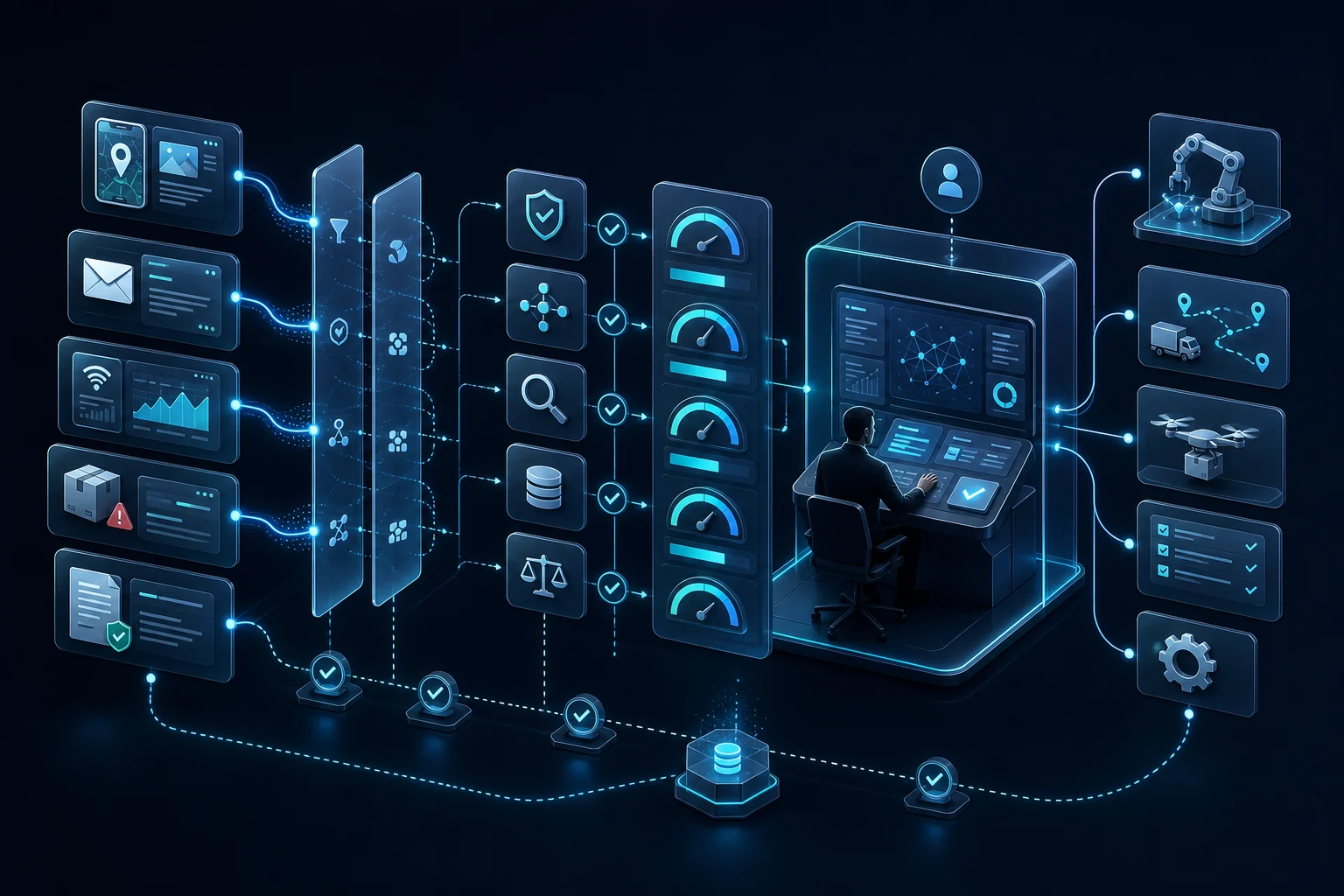
The minimum evidence packet before an agent touches operations
A practical evidence packet does not need to be complicated. It needs to be complete enough that a responsible operator can inspect the recommendation without reconstructing the whole workflow from memory.
1. Source identity
Capture the document, URL, system record, event feed, file, row, message, or sensor stream that supports the recommendation. If the system cannot name its source, the action should stay in draft mode.
2. Freshness and extraction basis
Record when the source was published, received, extracted, or last checked. Preserve the clause, field, status event, quote, or data element that actually supports the signal. Freshness matters because old facts can produce new mistakes.
3. Confidence context
Do not hide behind a decorative confidence score. Operators need to know whether a signal is confirmed by a primary source, corroborated by independent records, inferred from weak indicators, contradicted by another source, or blocked by missing evidence. VexASI's Signal Confidence Rubric is built for this exact operating need.
4. Authority boundary
Separate summarize, recommend, route, approve, and execute. A low-risk notification is not the same thing as changing a delivery promise, escalating premium freight, contacting an owner, adjusting production priority, or replacing a supplier.
5. Review and outcome record
Every meaningful agent recommendation should leave behind who reviewed it, what action was taken, what was rejected, and what happened afterward. That is how AI operations becomes a learning system instead of a stream of disposable suggestions.
Three examples where proof beats autonomy
AEC: project pursuit signals before business development action
An AEC agent can monitor permit activity, planning-board agendas, public funding notices, RFQs, addenda, owner hiring signals, and infrastructure coverage. The commercial value is not another generic project alert. It is a source-backed pursuit packet: what changed, who owns it, which geography and project type are implicated, how fresh the signal is, and what follow-up is authorized.
Example: an agent identifies a public meeting note and an early procurement signal that may indicate project momentum. Without source links, dates, jurisdiction context, and confidence labeling, the business development team gets noise. With the evidence packet, it gets a defensible reason to act earlier than competitors.
Advanced manufacturing: supplier and production exceptions
A manufacturing agent can summarize supplier notices, classify nonconformance notes, review maintenance logs, draft buyer escalations, or prioritize constraints. The proof layer connects each recommendation to part family, supplier, work order, inspection record, inventory position, production schedule, and customer-impact window.
Example: an agent recommends expediting a component because a supplier update and a production schedule conflict. The recommendation should carry the supplier source, extracted change, freshness note, inventory assumption, cost or customer-impact boundary, and named reviewer. If any piece is missing, the action should be treated as provisional.
Logistics and supply chain: fewer alerts, better exceptions
Logistics teams already operate inside noisy alert streams. Agentic AI can amplify that noise unless it proves why an exception matters. A useful logistics agent should attach service promise, carrier event, lane impact, warehouse constraint, inventory consequence, customs or tariff trigger, and escalation owner before recommending action.
Example: a carrier event and a warehouse constraint collide with a customer promise. The right agent does not simply draft an update. It produces the packet: shipment identifier, source event, time received, affected customer, alternate options, cost or service exposure, approval state, and follow-up record.

The board-level lesson: trust is an operating design choice
NIST's AI Risk Management Framework frames AI trustworthiness around governance, measurement, management, and risk practices across the AI lifecycle. That matters because agentic AI compresses the distance between model output and business action. The stronger the action rights, the stronger the evidence record should be.
Leaders do not need to block agentic AI. They need to stage it. Start with research and draft mode. Move to recommendation mode when the source packet is dependable. Move to routing mode only when review gates are clear. Move to execution only for low-risk, well-bounded actions with a visible audit trail and a rollback path.
A practical readiness checklist
- Can the receiving operator see the source trail without opening a developer console?
- Does the packet show what evidence is fresh, stale, missing, or contradictory?
- Are authority levels separated between summarize, recommend, route, approve, and execute?
- Is there a named human owner for customer-facing, financial, schedule, safety, compliance, or supplier-impacting actions?
- Can the team reconstruct why the action happened one week later?
- Can the outcome be used to improve source quality, thresholds, prompts, rules, or review gates?
Internal-link suggestions for VexASI readers
- AI Workflow Services for source-grounded agent and automation design.
- VexASI Signaling for public-evidence market and account intelligence.
- Methodology for the evidence-first workflow discipline.
- AI agents in critical operations for a companion article on evidence layers.
- Agentic AI in manufacturing for the infrastructure bottleneck view.
Sources consulted
- MIT Sloan: Agentic AI, explained.
- MIT News: Q&A on agentic AI and what we want it to be, published June 30, 2026.
- IBM: AI Agents in Supply Chain.
- NIST: AI Risk Management Framework.
- Google News discovery query for agentic AI, manufacturing, logistics, and supply-chain operations, reviewed July 3, 2026.
- Google News discovery query for AI operations in AEC, reviewed July 3, 2026.
Build the proof layer before agents touch the operating layer.
VexASI helps AEC, advanced manufacturing, logistics, and supply-chain teams convert noisy signals into source-grounded workflows with confidence context, review gates, and action records.
Request an evidence-first AI workflow scope