
The management conversation around AI agents changed this week because the operating question became harder to ignore. MIT News published a June 30, 2026 Q&A describing agentic AI as AI that takes actions in the world and cited a November 2025 MIT Sloan School of Management and Boston Consulting Group report finding that 35 percent of surveyed businesses had already deployed AI agents, with another 44 percent planning to implement them soon. The same interview warned that easy automation can reduce verification discipline and create problems such as bugs or private data leakage.
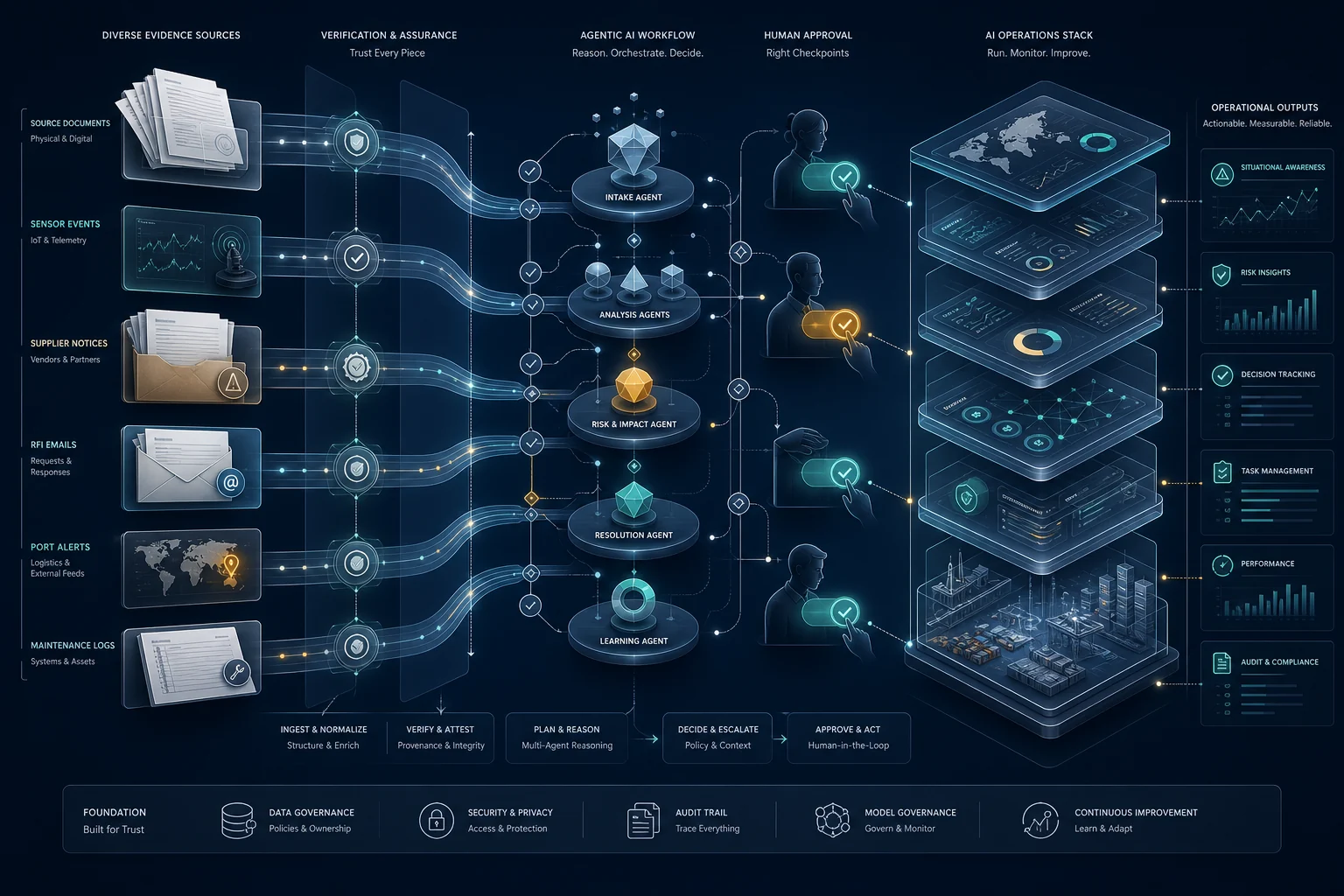
That combination is exactly why AEC, advanced manufacturing, logistics, and supply-chain leaders should slow down at one specific point: the evidence layer between signal and action. The practical question is not whether an agent can draft an email, summarize a bid, flag a supplier exception, or route a shipment issue. The practical question is whether the organization can prove what the agent saw, what it ignored, what rule it applied, what confidence context it carried, who reviewed it, and what happened after the handoff.
Current operating feeds reinforce the point. Construction Dive's July 1 headlines include infrastructure funding, construction labor demand, automation, data-center delivery, and public-project movement. Manufacturing Dive is tracking mobile automation, industrial robotics, semiconductor investment, defense production, and supply-base programs. Supply Chain Dive is tracking carrier capacity, tariff processes, robotics-enabled fulfillment, ocean freight pressure, and AI tools for pricing, inventory, and operations. These are not abstract AI use cases. They are recurring decision environments where stale, incomplete, or unverified signals become expensive.
Why the evidence layer is the new AI operations bottleneck
Most agent programs start with capability: what can the model do, which tools can it call, and how many steps can it complete without a human? Operators should invert the question. Start with the handoff that a real team member must trust.
An evidence layer is the structured record that travels with an AI-assisted recommendation. It is not a generic audit log buried in a platform console. It is the action-ready context the receiving owner needs at the point of work. For a permit issue, it may include the jurisdiction document, comment text, drawing set date, discipline owner, and unresolved assumption. For a production exception, it may include the work order, part family, inspection record, supplier history, and customer-impact window. For a logistics exception, it may include the shipment identifier, service commitment, carrier event, tariff or customs trigger, margin exposure, and alternate-lane assumption.
This layer becomes the bottleneck because AI makes weak handoffs faster. A fluent summary can hide missing evidence. A confident recommendation can hide a stale source. A routed task can create a downstream obligation without naming the human authority required. The risk is not only hallucination. The bigger operational risk is ambiguity moving at machine speed.
NIST's direction points to operational trust, not agent theatre
NIST's AI Risk Management Framework frames AI risk management around trustworthiness considerations in the design, development, use, and evaluation of AI products, services, and systems. The same NIST page notes the July 2024 Generative AI Profile and an April 7, 2026 concept note for a trustworthy AI profile in critical infrastructure. For VexASI's market, that direction matters because critical operations are not limited to government utilities. AEC programs, manufacturers, warehouses, carriers, and procurement teams all operate systems where AI recommendations can affect money, schedule, safety, customer promises, and compliance posture.
The evidence-first interpretation is simple: if an AI agent touches a decision that a business would not want to defend with only a chatbot transcript, the workflow needs a stronger record. That record should be visible to the operator, durable enough for after-action review, and specific enough to support correction when the agent was wrong.
What an evidence layer should contain
A practical evidence layer does not need to be overbuilt. It needs to capture the minimum fields required for trustworthy handoff and learning. In early deployments, VexASI would expect seven fields to matter most:
- Source identity: URL, file name, system record, document ID, feed name, or sensor/event source.
- Freshness: when the source was published, received, extracted, or last checked.
- Extraction basis: the exact clause, comment, status event, row, field, or source excerpt that supports the recommendation.
- Boundary: what the agent was asked to do, what it was not allowed to do, and what authority level applies.
- Confidence context: what evidence is strong, what is missing, and where sources conflict.
- Review state: human owner, approval requirement, escalation threshold, and timestamped disposition.
- Outcome hook: cycle-time saved, rework avoided, escalation prevented, exception resolved, or noise created.
These fields are commercially useful because they move AI from impressive output to operational memory. They let leaders ask which sources are reliable, which exceptions deserve automation, which teams are overloaded, and where agent recommendations repeatedly fail.
Sector examples: where the evidence packet pays for itself
AEC: project signals, permit movement, and bid risk
In AEC, public and private signals arrive through RFQs, addenda, permit comments, funding actions, owner updates, labor data, and design coordination records. An agent can summarize these feeds, but the value comes when the summary becomes a project-ready packet. A construction executive does not need more generic awareness; they need the relevant source, the dated event, the affected project or account, the likely owner, and the next action.
Example: an agent flags a public-project funding movement and a related RFQ. The evidence layer should retain the article or official notice, publication date, project geography, procurement milestone, confidence note, and recommended seller or operations follow-up. Without that packet, the signal is just another headline.
Advanced manufacturing: automation, procurement, and exception routing
Manufacturing teams are under pressure to combine automation, supply visibility, production reliability, and workforce constraints. Agents can draft supplier escalations, summarize downtime notes, classify nonconformance records, or prioritize procurement exceptions. The evidence layer should connect each recommendation to a part family, supplier, work order, inspection record, inventory position, customer commitment, and review owner.
Example: an agent recommends expediting a component because supplier news, incoming inspection history, and a production schedule conflict. That recommendation should not stand alone. It should carry source timestamps, the business rule used, missing confirmations, and the planner or buyer who accepted or rejected the action.
Logistics and supply chain: fewer alerts, better exceptions
Supply-chain teams already have too many alerts. More AI can make that worse if it amplifies noise. The commercial win is not more notifications; it is higher-quality exceptions. An evidence-first logistics agent should prove why an event matters: service promise, customer impact, cost exposure, lane risk, customs or tariff trigger, inventory consequence, and owner.
Example: a carrier capacity update and a tariff-process change both hit the same week. The useful agent does not merely summarize them. It identifies which lanes, customers, orders, or parts may be exposed, shows the sources, names assumptions, and routes the packet to the right operator for approval.

The executive checklist before giving agents more authority
Before moving from assistant-mode to action-mode, leaders can use a concise readiness test. If any answer is weak, keep the agent in draft, research, or recommendation mode until the workflow is stronger.
- Can the operator see the source trail without opening a separate technical log?
- Can the workflow show what evidence was missing or stale?
- Is there a named human owner for high-cost, safety-sensitive, customer-facing, or compliance-relevant decisions?
- Are authority levels separated between summarize, recommend, route, approve, and execute?
- Can the business measure whether the agent reduced cycle time, rework, escalation, or noise?
- Can a reviewer reconstruct why the action happened one week later?
This checklist is intentionally operational. It does not require a grand AI transformation program. It requires proof that the agent's output can survive contact with the business process.
Why this is VexASI's lane
VexASI's commercial position is evidence-first intelligence: converting messy public and internal signals into source-grounded, action-ready workflows. That is the missing layer between AI enthusiasm and durable operational value. The winners will not be the teams with the most agent demos. They will be the teams that can prove which signals deserve action, which actions require review, and which outcomes improved after the handoff.
For AEC, manufacturing, and logistics leaders, the next step is not to ask, "Where can we use agents?" The better question is, "Where do we already suffer from high-volume signals, recurring ambiguity, and costly handoffs?" Start there. Build the evidence layer. Then automate carefully.
Internal paths to connect this work
For teams turning this into an operating program, read AI Workflow Services, VexASI Signaling, the Signal Confidence Rubric, Methodology, Trust Center, AEC Signaling, Advanced Manufacturing Signaling, and Logistics Signaling.
Sources consulted
- MIT News, "Q&A: What is agentic AI today, and what do we want it to be?", published June 30, 2026.
- NIST AI Risk Management Framework, including the AI RMF overview, Generative AI Profile note, and April 7, 2026 critical-infrastructure profile concept note.
- Construction Dive latest news RSS, reviewed July 1, 2026 for AEC operating signals.
- Manufacturing Dive latest news RSS, reviewed July 1, 2026 for automation, robotics, procurement, and industrial-base signals.
- Supply Chain Dive latest news RSS, reviewed July 1, 2026 for carrier capacity, tariff, freight, robotics, and supply-chain AI signals.