Continuous-Monitor AI Operations: The New Evidence Layer for Supply Chain, Manufacturing, and AEC Risk
NIST's continuous-monitor-and-update direction for AI security, plus fresh supply-chain and manufacturing volatility, points to a practical operating shift: AI workflows need monitored evidence layers, not one-time automation launches.
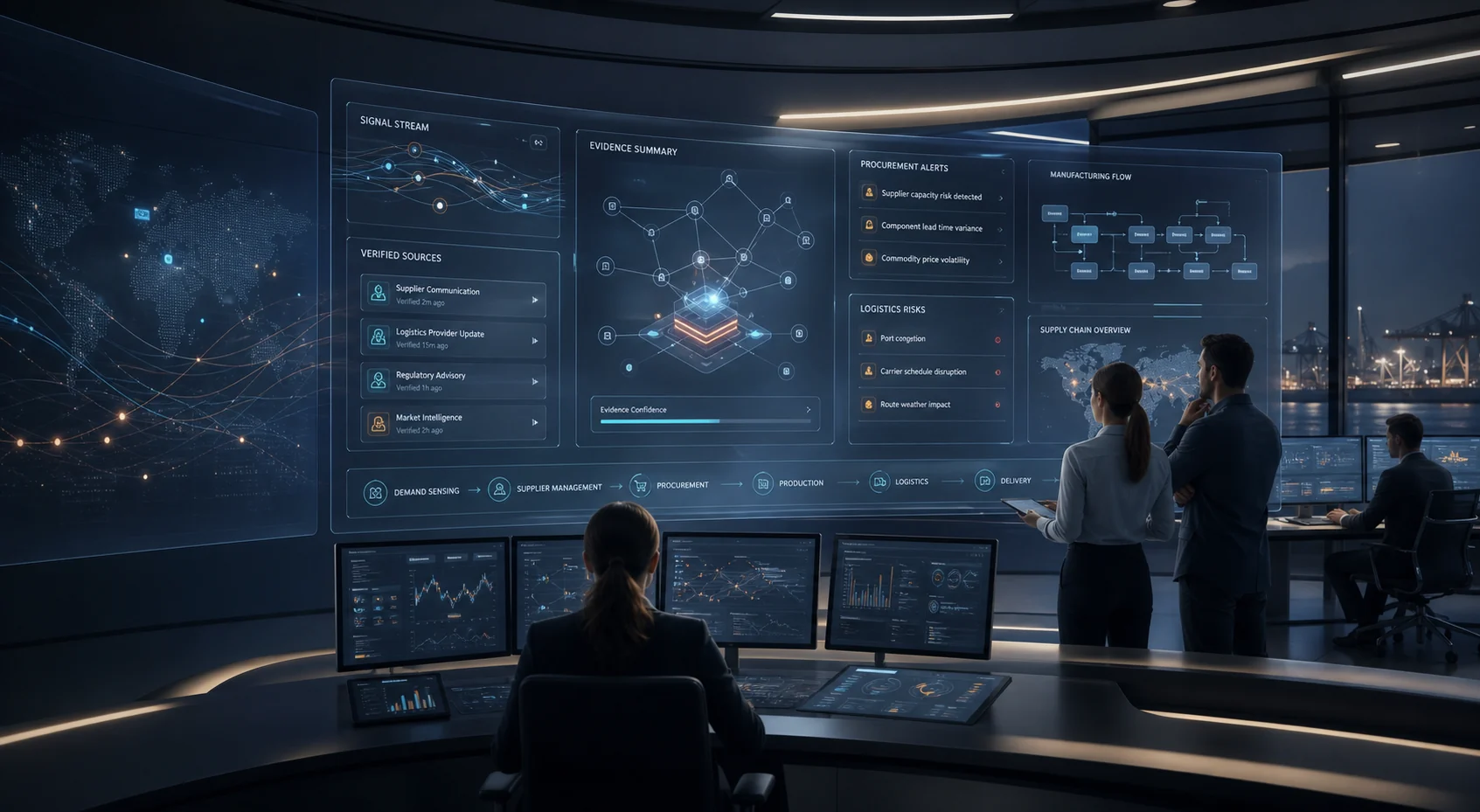
The next AI operations problem is not launch. It is monitoring.
AI programs are moving from isolated pilots into operational workflows that touch procurement, freight, project delivery, plant planning, vendor qualification, and customer commitments. That shift changes the risk profile. A workflow that looked accurate at launch can become wrong when tariffs change, suppliers reprice, project conditions move, freight lanes tighten, or model behavior drifts.
That is why the most useful AI operations question for 2026 is no longer “Can we automate this task?” It is “Can we continuously monitor the evidence that tells us whether this task is still safe, timely, and worth automating?”
NIST recently highlighted technical work supporting a continuous-monitor-and-update security model for AI systems. At the same time, sector reporting is showing the operational need for the same discipline: manufacturers are dealing with semiconductor commitments and data-standardization gaps, supply-chain teams are watching tariffs, rail investment, warehouse energy strategy, and AI partnerships, and construction leaders are managing project-planning volatility and structural-risk scrutiny.
Continuous monitoring turns market noise into governed exceptions
Most organizations already receive more alerts than they can use. Procurement teams track supplier updates. Logistics teams track carrier and lane conditions. Manufacturing leaders track capacity, materials, quality, uptime, and workforce constraints. AEC teams track permits, submittals, RFIs, weather, financing, and design coordination. The missing layer is not raw data. It is the operating discipline that decides which signal deserves action, who must review it, and what evidence supports the decision.
A continuous-monitor AI operations layer should do four jobs:
- Watch the right public and private signals. Track supplier announcements, tariff and policy movement, market capacity, critical project events, asset health, and internal operating thresholds.
- Attach source evidence to every exception. Show the source URL, timestamp, extraction method, confidence context, and reason the signal was promoted.
- Route only decision-grade exceptions. Separate watchlist items from review-required events.
- Keep an action ledger. Record why an AI workflow changed a queue, flagged a shipment, escalated a permit risk, or drafted a vendor message.

Where this matters first
Supply chain and logistics
Recent Supply Chain Dive reporting pointed to tariff-exemption activity, major rail-facility investment, warehouse energy strategy, and expanded supply-chain AI partnerships. Each signal can affect different teams in different ways. A tariff item may require procurement review. A rail investment may influence long-range network planning. An energy agreement may matter to site resilience or warehouse operating cost. A supplier AI partnership may be a capability signal, a dependency signal, or a vendor-risk signal.
The practical workflow is not to summarize everything. It is to classify each item by operational relevance: cost exposure, route exposure, supplier dependency, capacity timing, regulatory dependency, customer-impact risk, and decision owner.
Advanced manufacturing
Manufacturing Dive recently covered expanded U.S. semiconductor commitments, memory supply agreements involving automakers, and the need for manufacturing data standardization. Those stories point to the same bottleneck: AI workflows cannot make reliable planning decisions if the underlying evidence is inconsistent, late, or not tied to a decision process.
For manufacturers, continuous monitoring should connect external signals to internal constraints. If a chip supplier shifts capacity, which product lines are exposed? If a data-standardization gap prevents plant-level comparison, which AI recommendations should be downgraded until the evidence is normalized? If a major customer changes sourcing requirements, which engineering, quality, and procurement teams need the exception first?
AEC and infrastructure delivery
Construction Dive’s recent coverage of infrastructure work, data-center planning cooling, public-project updates, and legal exposure after a structural failure shows why AEC teams need evidence-first escalation. Project risk is rarely a single event. It accumulates across permit status, inspection outcomes, design coordination, supply constraints, site conditions, and contract obligations.
An AI assistant that only drafts summaries is useful but limited. An AI operations layer that monitors project signals, distinguishes weak indicators from verified exceptions, and routes evidence to the right reviewer is commercially more valuable.

A practical evidence layer for AI operations
For leaders evaluating AI operations platforms or internal agentic workflows, the minimum viable evidence layer should include:
- Signal source: where the input came from and whether it is public evidence, customer data, vendor material, or internal telemetry.
- Extraction trace: what was extracted, by which workflow, and what changed from the prior state.
- Confidence context: the reasons a signal is strong, weak, urgent, stale, contradicted, or unverified.
- Decision owner: the person or function accountable for reviewing the exception.
- Authority boundary: whether AI may notify, draft, recommend, queue, or act.
- Review outcome: accepted, rejected, deferred, escalated, or converted into a tracked action.
This is the difference between AI theater and operational intelligence. The evidence layer makes automation auditable enough for real teams to trust.
What leaders should ask this quarter
- Which signals would materially change a procurement, logistics, project, or production decision?
- Which of those signals can be verified from reliable sources?
- What threshold turns a monitored signal into a routed exception?
- Where must a human approve, reject, or override an AI recommendation?
- How will the organization prove why a decision was made after the fact?
If those answers are unclear, more autonomy will create more operational ambiguity. If those answers are explicit, AI can become a monitored decision-support system instead of an uncontrolled automation layer.
Internal-link suggestions
- VexASI Signaling for source-verified market evidence and account-relevant signal briefs.
- AI Workflow Services for governed routing, review gates, and action ledgers.
- The AI Operations Control Room.
- Signal Confidence Rubric.
Sources consulted
- NIST: Mathematical proof supports transition to a continuous-monitor-and-update security model for AI systems.
- Supply Chain Dive: tariff-exemption requests from Ford, Nestlé, and others.
- Supply Chain Dive: BNSF to build $4B rail facility in California.
- Supply Chain Dive: Scotts Miracle-Gro widens tech partnership for supply chain AI.
- Manufacturing Dive: manufacturing needs data standardization.
- Construction Dive: cooling data center surge caused slip in June construction planning.